biplup-run
An endless runner on hardware with no operating system. 16.8 MHz, and everything you get you have to ask for.
legally distinct
WHAT IT IS
A Pokemon themed endless runner for Game Boy Advance. An ARM7TDMI at 16.8 MHz with no operating system, so anything the game does, somebody has to write.
MY PART
- Project setup, and the Meson cross-compilation toolchain
- The unit test framework, and the tests that run in it
- Physics, collision and the high score. This is the part where I was learning
THE TOOLCHAIN
Cross-compiling C into a real GBA ROM with Meson, arm-none-eabi-gcc and ninja, set up to build from Windows, macOS or Linux. libtonc underneath for direct hardware access, which keeps full control without giving up every convenience.
A Pokemon themed endless runner for the Game Boy Advance, running in an emulator. The flashing kit worked. The cartridge we got was the wrong one.
TESTS ON A GAME BOY
Meson does not cross-compile tests well, or at least it did not then. Running a test means running it on the target, and the target is a Game Boy. So the framework had to exist before any of the tests could.
A Game Boy has nowhere to print to. No terminal, no stdout, nothing watching. So the tests are their own ROM, and the results get drawn on the screen.
snprintf(test_buffer, sizeof(test_buffer),
         "system_utils.c:\n\n%d%d%d\n\ntext.c:\n\n%d%d%d%d\n\n..."
         SYSTEM_UTILS_TESTS, TEXT_TESTS, INPUT_TESTS,
         OBJECT_UTILS_TESTS, KINEMATICS_TESTS);

while (true) {
  tte_set_pos(5, 7);
  tte_write(test_buffer);
}
#define INPUT_TESTS \
test_pregame_reset_score(), test_pregame_reset_frame(), \
test_pregame_to_game(), test_jump_state(), ...one digit per test, read off the screen
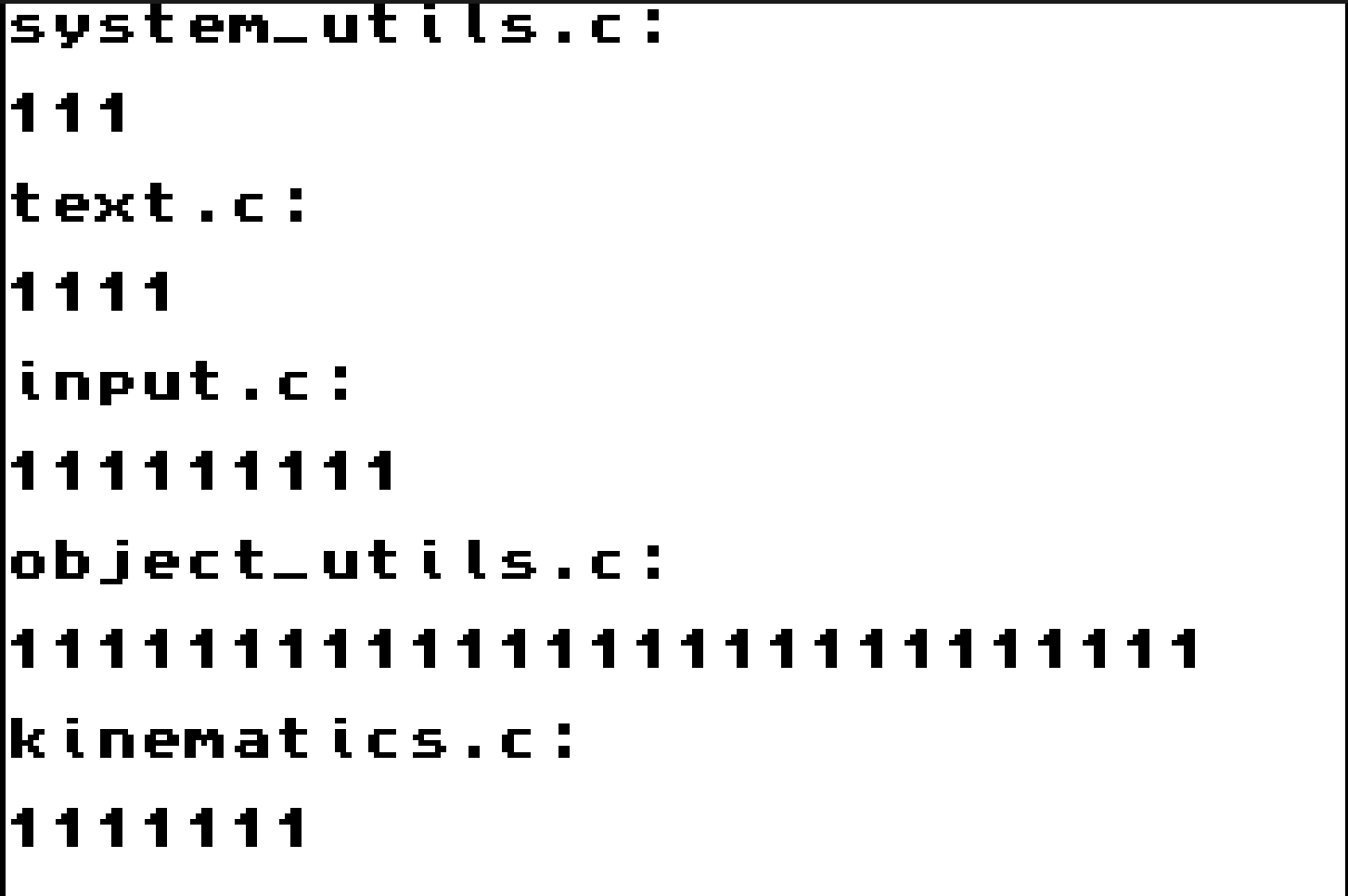
Every test returns 1 or 0. A macro expands a whole file worth of tests into a comma separated list, so each one lands as a single digit on screen and you read the results off the screen.
WHERE IT LANDED
Four of us over about five weeks, for Software Systems. A lot of it was pair programmed, sat at one machine, which is why the commit history reads the way it does.